The Real Cost of SME Credit in Latin America
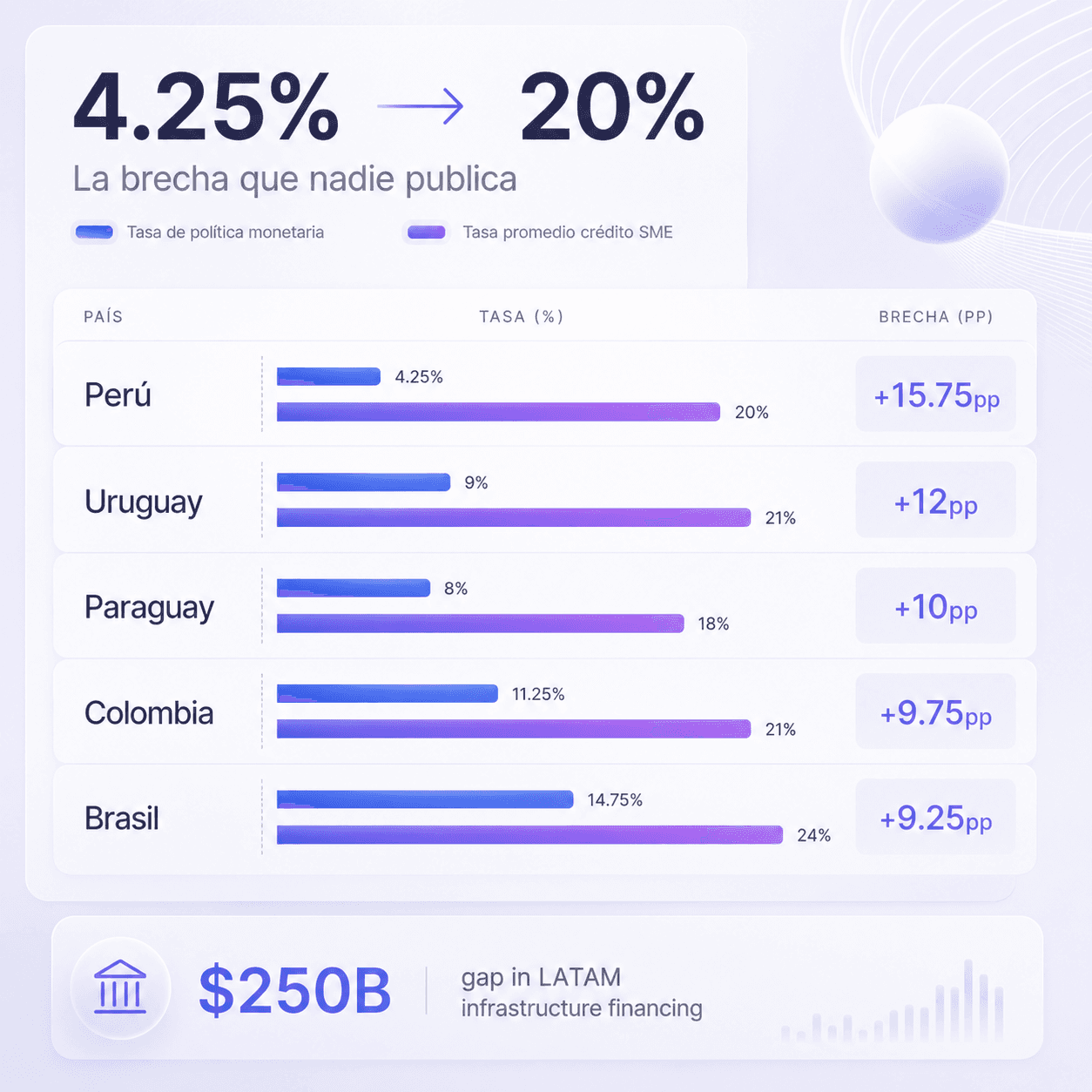
The central bank rate in Peru is 4.25%. A large corporation borrows at 7%. A small business? It pays 20%, if it can get a loan at all.
This is the reality of credit in Latin America: a region where policy rates make headlines, but the rates that matter, the ones small and medium enterprises actually pay, remain invisible.
We mapped the full rate stack across 10 LATAM countries, from policy rate to informal lending. The data reveals a structural pricing crisis that no amount of monetary policy can fix.
The Rate Stack Nobody Publishes
Every country has a "headline rate", the policy rate set by its central bank. Financial media reports on it. Analysts forecast it. But between that rate and what a small business operator actually pays, there are 4-6 intermediation layers, each adding 2-5 percentage points.
| Country | Policy Rate | Corporate Rate | PYME Rate | Informal Rate | Policy→PYME Gap |
|---|---|---|---|---|---|
| Chile | 4.5% | 6-8% | 11% | 18-25% | 6.5pp |
| Peru | 4.25% | 6-7% | 20% | 25-60% | 15.75pp |
| Colombia | 11.25% | 13-14% | 21% | 30-50% | 9.75pp |
| Mexico | 9.5% | 9-10% | 16.5% | 25-30% | 7pp |
| Brazil | 14.75% | 16-18% | 24% | 40-60% | 9.25pp |
| Ecuador | 8% | 7% | 10.5% | 15-20% | 2.5pp |
| Costa Rica | 6% | 7-9% | 12% | 15-20% | 6pp |
| Panama | 5.5% | 7-9% | 10% | 12-18% | 4.5pp |
| Uruguay | 9% | 12-13% | 21% | 25-35% | 12pp |
| Paraguay | 8% | 10-13% | 18% | 20-30% | 10pp |
Sources: OECD SME Scoreboard 2024, SBS Peru, BCU Uruguay, CMF Chile, SuperFinanciera Colombia, Banxico, BCB Brazil
The gap between policy rate and what SMEs pay ranges from 2.5 percentage points (Ecuador) to 15.75 points (Peru). This isn't a policy failure; it's a structural feature of how credit markets are designed.
Peru: The OECD's Largest PYME-Corporate Spread
Peru deserves special attention. The OECD's Financing SMEs and Entrepreneurs Scoreboard identifies Peru as having the largest PYME-corporate interest rate spread among all measured economies.
A large Peruvian corporation borrows at 6-7%. The same bank charges a small business 20-27%. That's a spread of 13-20 percentage points, for operating in the same country, under the same macroeconomic conditions.
The SBS (Superintendencia de Banca, Seguros y AFP) publishes sector-level data that confirms this: microenterprise rates regularly exceed 30%, and consumer credit rates, which many small business operators resort to, reach 40-45%.
For context, Peru's central bank rate is 4.25%. The credit transmission mechanism adds nearly 16 percentage points before reaching a small business.
Why the Gap Exists
The PYME-corporate spread isn't arbitrary. It's the result of five structural forces:
1. Information asymmetry. Large companies have audited financials, credit ratings, and established banking relationships. SMEs often have none of these. Banks compensate for uncertainty with higher rates.
2. Underwriting cost economics. It costs a bank roughly the same to underwrite a $50K loan as a $50M loan. The fixed cost of due diligence makes small tickets unprofitable at corporate rates.
3. Collateral mismatch. Banks require real estate or cash equivalents as collateral. Most SME operators have their capital tied up in operating assets, solar panels, vehicles, servers, machinery, that banks don't accept.
4. Regulatory capital requirements. Basel III and local regulations require banks to hold more capital against SME loans (higher risk weights). This capital cost gets passed through as higher rates.
5. Limited competition. In most LATAM markets, 4-6 banks control 70-80% of commercial lending. With limited competitive pressure, there's no incentive to price aggressively for SME segments.
The Informal Market: Where Rejected Operators End Up
When banks say no, and they say no to approximately 70% of LATAM SMEs seeking formal credit, operators don't stop needing capital. They turn to informal markets.
In Peru, informal lending rates range from 25% to 60%. In Brazil, the equivalent market charges 40-60%. In Colombia, rates between 30-50% are standard, often enforced through mechanisms that have nothing to do with financial regulation.
The informal market exists because the formal market fails. Every percentage point added to the formal PYME rate pushes more operators toward unregulated alternatives.
The $250 Billion Gap
The Inter-American Development Bank estimates that Latin America faces a $250 billion annual infrastructure financing gap. This isn't hypothetical demand; it represents real assets that could be generating revenue, employing people, and building productive capacity.
The gap exists not because the assets are bad, but because the financing system wasn't designed to evaluate them. Banks evaluate borrowers. The assets, their cash flows, their contracts, their revenue history, are secondary to the operator's credit profile.
What the Data Tells Us
Three conclusions emerge from this analysis:
First, monetary policy doesn't reach SMEs. Central banks can cut rates to zero, but the structural intermediation layers ensure that SMEs always pay a significant premium. The transmission mechanism is broken at the retail level.
Second, the gap is an inefficiency, not a risk premium. If PYME default rates justified a 15-20pp spread over corporate rates, the informal market, with even higher rates and worse underwriting, couldn't exist. The spread reflects structural friction, not actuarial risk.
Third, the solution must bypass the intermediation stack. No amount of bank reform will compress 6 intermediation layers into 1. The capital must flow from investors to operators through infrastructure that doesn't carry the legacy cost structure.
The Alternative
What if you could evaluate the asset instead of the borrower? What if a solar installation's 20-year power purchase agreement, or a SaaS platform's monthly recurring revenue, or a fleet's service contracts could serve as the basis for financing, regardless of whether the operator has 3 years of audited financials?
This is the thesis behind asset-based alternative financing. Not replacing banks, but serving the market they structurally cannot reach.
The data is clear: LATAM's SME credit market isn't broken because of bad policy. It's broken because of architecture. Fixing it requires new rails.
This analysis uses data from the OECD SME Financing Scoreboard 2024, central bank publications from Peru (SBS/BCRP), Uruguay (BCU), Chile (CMF/BCCh), Colombia (SuperFinanciera/BanRep), Mexico (Banxico), and Brazil (BCB). All rates referenced are as of Q1 2026.